Daily Skincare Routine Log Book KDP: A Practical Evaluation for Self-Publishers
When preparing a low-content or medium-content book for Amazon Kindle Direct Publishing, the interior file is often the most time-consuming element to create from scratch. The Daily Skincare Routine Log Book KDP interior is a pre-designed template intended to simplify this process for authors and publishers focused on health, beauty, or personal tracking niches. This article evaluates the product based on its stated features, explores the situations where it may be a strong fit, and considers alternatives for those whose needs differ.
What Is the Daily Skincare Routine Log Book KDP Interior?
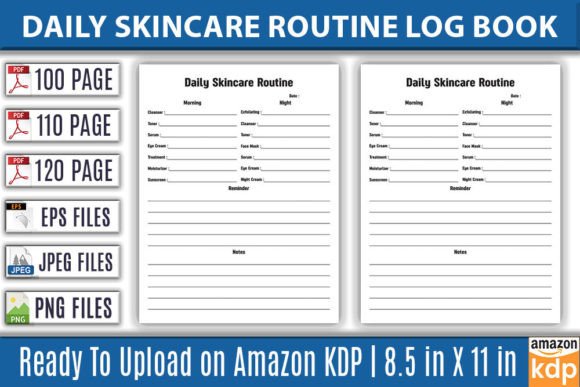
This product is a set of files designed for upload as the interior of a skincare routine log book on Amazon KDP. It is not a finished book, but rather the inner pages that users can pair with their own cover and listing details. The interior is offered in three page count options: 100, 110, and 120 pages, all with a trim size of 8.5×11 inches. The files are created at 300 DPI resolution with no bleed settings, which makes them compliant with KDP’s standard requirements. The package includes a print-ready PDF, editable EPS files, transparent PNG files, and bonus high-resolution JPG images. The keyword “Daily Skincare Routine Log Book KDP in” appears in the product’s description, emphasizing its specific application for self-publishers targeting Amazon’s platform.
Because the files are described as KDP tested and ready for upload, the primary value proposition is convenience: the user can download, optionally customize, and upload without needing to design pages from scratch or test for format errors.
Who Might Be Interested in This Product?
Several types of self-publishers may find this interior appealing. Those who are new to KDP and want a low-risk way to publish a log book will benefit from a tested file that reduces the chance of upload errors. Experienced publishers who need to quickly expand their catalog of skincare or habit-tracking titles may also use it to save time. Additionally, content creators who prefer to focus on cover design and marketing rather than page layout will find the pre-prepared interior a practical starting point.
People researching the phrase “Daily Skincare Routine Log Book KDP in” are likely comparing similar products or evaluating whether a ready-made interior meets their quality and flexibility standards. The interior is specifically tailored for a daily skincare log, which implies a structured layout with spaces for date, time, product used, and notes—though the exact page design is not detailed in the feature list, the specifications suggest a clean, functional layout suitable for repeated daily entries.
Benefits of Using a Pre-Designed KDP Interior
The primary benefit is time savings. Designing a 120-page interior from scratch, including formatting for KDP’s specifications, can take several hours or even days for inexperienced users. This product eliminates that effort. The fact that the files are KDP tested is a practical advantage: it reduces the risk of the book being rejected during upload due to margin, resolution, or bleed errors.
Another benefit is the inclusion of multiple file formats. The EPS files allow for customization in vector editing software, while the PNG and JPG files provide immediate use in other design contexts. This flexibility is useful if the publisher wants to adjust the layout, add branding, or repurpose the graphics for marketing materials.
The three page count options give the publisher some control over the thickness of the book. A 100-page book is lighter and less expensive to print, which may appeal to price-sensitive buyers. A 120-page book feels more substantial and may command a higher price point. Having these choices allows the user to align the product with their target market without needing to redesign the interior.
Tradeoffs to Consider
While the interior offers convenience, there are tradeoffs. The fixed trim size of 8.5×11 inches is standard for workbooks and log books, but it limits the publisher to a single format. If your target audience prefers a smaller, more portable size such as 6×9 inches or a pocket-sized book, this interior will not suit those needs.
The “no bleed” specification means that all content must remain within the safe margins, and no elements extend to the edge of the page. This is standard for many KDP interiors, but if you intend to add full-page background colors, images, or designs that reach the edge, you would need a bleed version. The absence of bleed in this product means it is best suited for simple, clean layouts with white or light backgrounds.
Another consideration is the fixed page count increments. The product offers 100, 110, or 120 pages. If you need a different number, such as 90 pages or 150 pages, you would need to modify the file yourself or look for an alternative. Similarly, the 300 DPI resolution is excellent for print quality, but it also means larger file sizes. While KDP handles 300 DPI files well, some users may find it unnecessary for a simple log book interior, though it does ensure sharp text and lines.
When Is This Interior a Strong Fit?
This product is a strong fit for self-publishers who value speed and compliance over customization. If your goal is to launch a skincare log book within a few days, and you do not require a unique layout, then this interior provides a reliable foundation. It is also a good choice if you are testing a niche: you can quickly publish a book, gauge market interest, and then invest in a custom design later if the book sells well.
Publishers who already have a cover design ready and just need an interior that meets KDP specifications will find the tested PDF especially useful. The inclusion of editable EPS files also makes this a good choice if you want to make small modifications—such as adding your logo, changing header fonts, or adjusting the number of entry fields—without starting from zero.
Additionally, this interior may appeal to those who want to bundle a log book with other skincare products or courses. The clean, standardized layout can serve as a functional tool for customers who want to track their routines, rather than a decorative journal.
When to Consider Alternatives
If you require a different trim size, particularly a smaller or more niche size, you will need a custom interior or a different template. Similarly, if you want a layout with bleed for full-color backgrounds or edge-to-edge designs, this product will not work without modification.
Publishers who need a unique page count, such as volumes with exactly 80 pages or 150 pages, may find the fixed options limiting. While you could duplicate or remove pages in the editable files, that adds effort and may compromise the tested status of the file. If you have strict requirements for page count due to printing costs or perceived value, you may prefer to create a custom interior.
Another alternative is using a general-purpose log book template and adapting it for skincare. Many online marketplaces offer generic diary or habit tracker interiors that can be repurposed. However, these may not have the specific field labels or layout that a dedicated skincare log book buyer expects. The Daily Skincare Routine Log Book KDP interior is niche-specific, which can be an advantage for targeting, but if you want a broader log book that works for multiple topics, a generic template may be more versatile.
Finally, if you prefer full control over every design element—typography, line spacing, iconography, or even the paper color effect—building your own interior using software like Adobe InDesign, Canva, or even Microsoft Word gives you complete freedom. The tradeoff is the time investment and the need to ensure KDP compliance on your own.
Practical Decision-Making Insights
To decide whether this interior is right for you, start by clarifying your goals. List the following:
- What trim size do you want? If 8.5×11 is acceptable, proceed to the next criteria.
- How many pages do you need? If 100, 110, or 120 pages fit your content plan, this product is a candidate.
- Do you need bleed? If your design does not require edge-to-edge elements, no bleed is fine and simplifies the upload.
- How important is customization? If you plan to edit the files, the EPS format is essential. If you only need a print-ready PDF, the included file suffices.
- What is your timeline? If you want to upload within hours, the tested PDF is a major advantage.
Also consider your audience. A skincare routine log book is often used by people who are methodical about their beauty habits, so the interior should support clear, easy tracking. The 300 DPI resolution ensures that the print quality is high, which contributes to a professional feel. If your target readers value aesthetics, you may want to add some minimal design elements using the editable files, but the base layout should be functional.
Comparative Value
Compared to hiring a freelance designer, this interior is significantly cheaper. A custom interior for a 100+ page log book can cost anywhere from 50 to 200 dollars, depending on complexity. This product offers a tested, multi-format package at a fraction of that cost, making it a practical option for budget-conscious publishers. The tradeoff is that you receive a standard design rather than a bespoke one, which could be a limitation if you are building a brand with a very specific visual identity.
Another comparison point is using KDP’s own free interior templates, which are available for some categories. Those templates are generic, often in black and white, and may not include the specific layout for a skincare log. The Daily Skincare Routine Log Book KDP interior is niche-tailored, which can save you the time of reformatting a generic template to fit a skincare tracking purpose.
Expectations for Upload and Use
Because the files are described as KDP tested, the expectation is that they will pass KDP’s validation checks for margins, resolution, and file format. However, it is still advisable to preview the PDF using KDP’s online previewer or download a proof copy before publishing. Even tested files can have issues when combined with a specific cover or when uploaded to different marketplaces. The no-bleed setting also means that you should not add borderless elements without editing the file first.
The inclusion of transparent PNG files suggests that you can use elements of the design for marketing images, social media posts, or book mockups. The high-resolution JPG files serve a similar purpose. This adds value beyond the interior itself, as you can create cohesive promotional materials using the same design language.
Aligning the Product with Your Goals
If your primary goal is to publish a skincare log book quickly with minimal effort, and you are comfortable with an 8.5×11 inch format and page counts of 100 to 120, then this interior aligns well with your needs. It removes the most tedious part of the process—formatting and testing—and provides flexibility through editable files if you decide to customize later.
If your goals include offering a unique product, experimenting with different sizes, or building a line of journals with a consistent but customizable look, then you may want to use this as a starting point and modify it, or look for a more comprehensive template package that offers multiple sizes and bleeds.
Ultimately, the Daily Skincare Routine Log Book KDP interior is a tool that trades uniqueness for efficiency. For many self-publishers, that tradeoff is worthwhile, especially when entering a niche or testing the market. By understanding both its strengths and limitations, you can make an informed decision that supports your publishing strategy.