Peony Flower Line Drawing Coloring Pages
When you work with printable coloring pages for commercial or personal projects, the quality of the base line art determines everything that follows. Peony Flower Line Drawing Coloring Pages deliver precisely that foundation—vector-based illustrations created in Adobe Illustrator, available in multiple formats so you can edit, resize, and repurpose them without losing a single detail. Whether you are building an adult coloring book for Amazon KDP, designing sublimation templates for mugs and pillows, or creating stickers and greeting cards, this set gives you clean, scalable line work that fits seamlessly into your existing workflow.
What This Digital Set Actually Contains
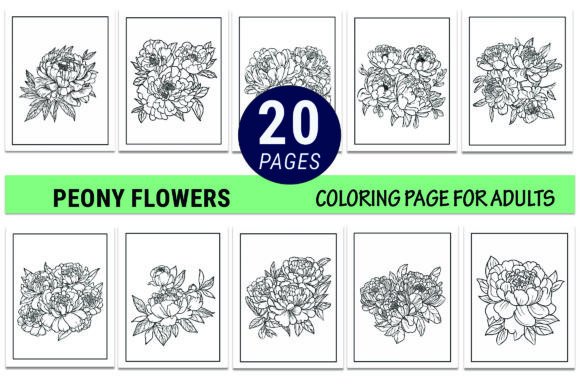
The core of the product is a collection of line drawings featuring peonies, delphiniums, and larkspur—the July birth flower. Each illustration is vector art, measured for an 8.5 × 11 inch page, which means the files are print-ready at standard US letter size. The ZIP folder includes twenty files in each of these formats: AI, PDF, EPS, DXF, PNG, SVG, and JPG. That level of format coverage is not just a bonus; it directly affects how you can use the drawings across different software, platforms, and production methods.
Having the native AI files allows you to open the illustrations in Adobe Illustrator and modify individual paths, adjust stroke weights, or combine elements. The EPS and SVG versions work well in vector editors like CorelDRAW or Inkscape. PDFs are universal and can be uploaded directly to Amazon KDP with no additional conversion. PNG and JPG give you raster options for quick previews or use in programs that don’t support vectors. DXF is useful for laser cutting or CNC applications if you want to etch the design onto physical surfaces.
Where Peony Flower Line Drawing Coloring Pages Fit in Your Process
Think of this resource as a flexible starting point that you can place before, during, or after different stages of a project, depending on your objective.
Before a Creative Project: Planning and Asset Preparation
If you are designing an adult coloring book for KDP, you need interior pages that are clear, consistent, and appealing to your target audience. Instead of drawing each illustration from scratch, you can use these pre-made line drawings as a base. Open the AI file, check the page size is set to 8.5 × 11 inches with proper bleed margins if needed (usually 0.125 inch extra on each side), and ensure the line color is set to a grayscale value that prints well—something around 30–50% black works for most coloring books. You can rearrange the order of the pages, combine multiple illustrations, or add your own titles and borders.
For physical product entrepreneurs, these drawings function as a design library. You can pull the SVG or EPS version into your vector software and test how the peony or delphinium shapes look on a mock-up of a mug, a pillow, or a t-shirt. Because the art is vector, you can scale it to fit small stickers or large blankets without pixelation. That means you can plan a product line around a consistent floral theme without redrawing the same motifs.
During a Project: Editing and Customization
The most practical advantage of having editable vector files is the ability to modify the line art to match your brand or aesthetic. For instance, you may want to simplify a complex delphinium line drawing for a children’s coloring page, or thicken the strokes for a cleaner look when used in sublimation. In Adobe Illustrator, you can select all paths and adjust the stroke weight globally, change the stroke color, or convert strokes to outlines for further distortion effects.
If you are working on a July birth flower themed book, you can organize the twenty drawings into chapters or sections, each highlighting a specific bloom. Since the files come individually, you can import each AI file into a master document and arrange them in any sequence. The PDF format is especially useful for proofing—you can print a single page to test the inking and paper interaction before committing to a full print run.
For those using print-on-demand services, consistency is critical. When you upload to platforms like Amazon KDP, the file format and page size must match exactly. The supplied PDFs are already sized at 8.5 × 11 inches, so you can upload them directly. However, always double-check that your PDF is set to “PDF for print” with no compression that could thin out the lines. You might also need to embed fonts if you add text, but the line art itself uses no fonts, so that reduces a common headache.
After a Project: Repurposing for Multiple Products
One of the strongest features of this collection is how it supports long-term use across different mediums. After you have published a coloring book on KDP, you still have all the vector files ready for other applications. The same peony drawing you used on page 12 can become a sublimation design for a ceramic mug, a sticker sheet for a shop, or the central motif on a t-shirt. Because the PNG files have transparent backgrounds (assuming they were exported that way), you can drop them directly into a design template without additional masking.
You can also use the DXF files to cut stencils on a Cricut or Silhouette machine. The delicate lines of the larkspur flowers translate well into stencils for fabric painting or wall art. The SVG files are easily loaded into web design tools if you want to create digital products like printable wall art or digital planner stickers.
Practical Implementation Tips
To get the most out of Peony Flower Line Drawing Coloring Pages, treat the ZIP file as a master archive. Unzip the folder and create subfolders by format, but also keep a working copy in your preferred vector format. I recommend using the AI files for all major edits because they preserve layer structure and project settings. If you are sharing files with a collaborator who uses different software, provide EPS or SVG versions to avoid compatibility issues.
When preparing for Amazon KDP, open the PDF version and check the file properties. KDP requires PDFs to be in PDF/X-1a or PDF/X-3 standard for print. Most vector software can export to these standards. Also, verify that the line art is set to CMYK if you intend to print professionally, though line art in grayscale or black-only is typical for coloring books. For sublimation, you may want to convert the vector to a Photoshop file with a transparent background and then apply it to your product template at 300 DPI.
Organization matters when you have twenty separate designs. Create a naming convention that includes the flower type and a sequence number, for example “Peony_01.ai”, “Delphinium_04.ai”. This will save time when you need to find a specific drawing for a reprint or a new product variation. Keep a spreadsheet logging which designs you have used for which products, so you can avoid duplicate use in a single book or product line.
Factors That Affect Quality and Consistency
Vector line drawings are inherently resolution-independent, but final quality still depends on how you handle them. When you scale a design up, the stroke weight remains physically the same if you don’t adjust it. For a mug, a thin stroke may disappear during sublimation because the ink spreads slightly. Consider thickening strokes if you plan to use the designs on absorbent surfaces. For coloring pages, thinner strokes are usually preferable because they allow colored pencil or marker details to cover the lines without bulk.
Another factor is the file format choice for your end use. PNG is fine for digital previews, but for print-on-demand products like pillows or mugs, use a layered vector file so you can separate the drawing from the background. The SVG format is excellent for web and CNC, but if you need to preserve exact color for print, EPS with CMYK settings is more reliable.
Long-term usability also depends on how you store the files. The ZIP folder contains twenty of each format, which is a lot of individual files. I recommend backing them up to cloud storage and also keeping a local copy in a dedicated assets folder for your branding projects. Over time, you will find yourself returning to these illustrations again because they are easy to modify and combine.
Integrating the Set into a Larger Workflow
If you are a small business owner selling on Etsy or using print-on-demand, this collection can serve as a recurring resource for new product releases. For example, you could create a seasonal line of July birth flower gifts using the delphinium and larkspur drawings. Launch a coloring book on KDP, then use the same art to produce a set of greeting cards and a mug design. Because the vector files are consistent, your brand will look cohesive across different product categories.
For educators and bloggers, the line drawings can be used as teaching aids or free printables to attract visitors. You can extract a single peony illustration, add a caption, and offer it as a coloring sheet in a blog post about flower anatomy. The transparent PNG versions are particularly useful for digital resources because they can be placed over any background.
Freelancers and designers can incorporate these drawings into client projects that require floral line art. Instead of spending hours drawing from scratch, you have a library of twenty professional-grade motifs that you can adapt to specific briefs. The AI files allow you to quickly change the style—for instance, you can expand all strokes and apply a roughen effect for a hand-drawn look, or convert them into contour line art for a minimalistic poster.
Final Observations
The value of Peony Flower Line Drawing Coloring Pages lies in its format variety and clean vector construction. It removes the need to create original line art from scratch and gives you the freedom to apply the drawings across multiple channels—publishing, merchandise, digital products, and craft projects. The inclusion of Delphinium and Larkspur as July birth flowers adds a thematic layer that can be marketed to birthday gift buyers, gardeners, or lovers of cottagecore aesthetics.
When you integrate this set into your workflow, start by identifying your primary output. If it is an Amazon KDP coloring book, use the PDF directly after checking print standards. If it is sublimation merchandise, work from the AI or EPS files and adjust stroke weights. If you plan to cut stencils, the DXF format saves you conversion time. By matching the right format to each stage of your process, you make the designs work harder for you without extra effort.
Consistency across projects, efficient editing, and repurposing are the real benefits here. The twenty drawings give you enough variety to build a substantial product line, while the multiple formats ensure compatibility with nearly any tool or platform you use. Whether you are a publisher, a product designer, or a hobbyist, having this kind of adaptable vector resource means you can focus on the creative and business decisions that matter most, rather than the technical grinding of drawing lines one more time.