Mom, Tell Me Your Story Amazon KDP KIT: A Strategic Tool for the Mother’s Day Niche and Beyond
Timing matters in publishing. With Mother’s Day celebrations scattered across the globe from March through May, the weeks leading up to this period represent one of the most predictable and commercially relevant windows for creators. If you are already working with Amazon KDP, or considering a focused entry into print-on-demand publishing, the Mom, Tell Me Your Story Amazon KDP KIT offers a structured path into a niche that combines emotional resonance with consistent buyer intent.
This is not a generic template pack. It is a coordinated set of assets and prompts designed to help you produce a keepsake guided journal, a category that consistently ranks well because it serves a real human need: preserving a parent’s memories. But what makes this kit strategically useful extends beyond its immediate theme. Let’s examine how to approach it with clear goals, what it can support in your broader publishing or creative workflow, and what you should consider before relying on it.
What the Kit Contains and Why That Matters for Your Workflow
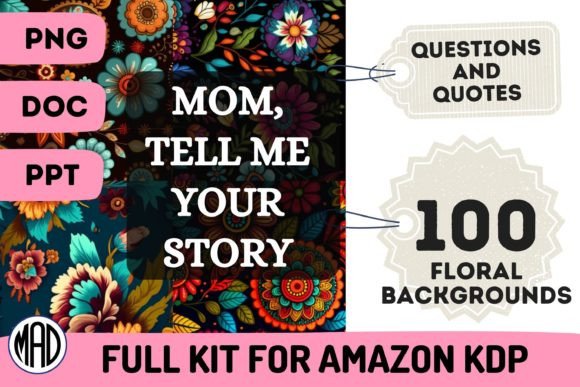
Before diving into strategy, it helps to understand what you are working with. The ZIP file includes a Mother’s Day Work Folder containing a cover template with instructions, 100 high-resolution PNG files of floral backgrounds, bonus materials such as Mother’s Day word searches, a Helium10 report on Mother’s Day niches, an example photo of a question generated from ChatGPT, and a Mother’s Day flyer. The second major component is the “Mom, Tell Me Your Story” introduction, which includes 100 questions, 100 quotes, and keyword suggestions.
From a production standpoint, this structure reduces the time between concept and publication. If you are familiar with Canva, Adobe Illustrator, Inkscape, or similar tools, you can assemble a complete book in two to five days. That speed is notable because it allows you to test the niche without committing weeks of development time. For a small business owner or solo creator, that kind of efficiency directly supports operational agility.
Strategic Use Cases for Publishers and Creators
The obvious application is publishing a guided journal on Amazon KDP. But the kit’s value extends into several adjacent areas if you approach it with intention.
Positioning a Seasonal Product Line
If you already sell printables, journals, or paper products, Mother’s Day can anchor a short seasonal line. The kit gives you a coherent design language through the floral backgrounds and the curated question set. Rather than piecing together assets from multiple sources, you have a consistent visual and thematic foundation. This helps with branding because your products across different platforms—Amazon, Etsy, or your own site—will share a recognizable look.
The Helium10 report included in the kit is particularly useful here. It provides search volume and competition data for Mother’s Day niches. That information lets you make informed decisions about which keywords to target and how to position your book against existing titles. Without this data, you are guessing. With it, you have a baseline for prioritization.
Supporting Content Creation Beyond Books
The 100 high-resolution 300 DPI floral background illustrations are not limited to book interiors. They work for sublimation projects, bag designs, cards, frame artwork, mugs, pillows, scrapbooks, t-shirts, stickers, wedding stationery, decoupage, and papercraft. If you run a craft business or a print-on-demand store, these assets can serve multiple product lines. A single kit can therefore support your entire Mother’s Day product range, from journals to home decor to apparel.
This kind of reuse improves your return on investment. One asset purchase feeds multiple revenue streams, which is a practical consideration for anyone managing tight margins or limited production time.
Building a Content-Driven Brand Around Memory-Keeping
The concept of “Mom, Tell Me Your Story” taps into a broader trend: people want to capture family histories before they fade. If you are a blogger, educator, or content creator, the 100 questions in the kit can be repurposed into blog posts, social media prompts, email sequences, or even podcast episodes. The quotes can serve as social graphics or newsletter headers. The kit becomes less a finished product and more a content library you can draw from throughout the year, not just in the weeks before Mother’s Day.
This shifts the kit from a one-time publishing tool to a long-term resource for audience engagement. That is a more strategic use of the asset than simply publishing one book and moving on.
Planning Considerations Before You Start
Using the kit effectively requires a few decisions upfront. The most important is clarifying your end goal. Are you publishing a single journal to test the niche? Are you building a series of memory-keeping products? Or are you primarily after the floral assets for a broader craft line? Each goal leads to a different workflow and a different measure of success.
Define Your Format and Platform
The kit is optimized for Amazon KDP, but you can adapt the assets for other platforms. If you plan to sell on Etsy as a printable PDF, the formatting requirements differ from a printed book sold via KDP. Decide this before you start designing. The cover template and instructions are geared toward KDP’s specific trim sizes and bleed requirements. If you repurpose the assets for another platform, you may need to adjust margins, resolution, or file type.
Similarly, if you intend to use the floral backgrounds for sublimation, confirm that your printer and substrate work well with the PNG files provided. They are 300 DPI, which is standard for high-quality print, but you should test a sample before committing to a production run.
Assess the Competition with the Helium10 Data
The bonus Helium10 report is one of the most actionable pieces of the kit. Take time to study it before you begin designing. Look for niches with decent search volume but manageable competition. The data can help you decide which angle to emphasize: a simple question-and-answer journal, a more structured keepsake with prompts and spaces for photos, or a hybrid that includes quotes and word searches as filler content.
Ignoring this data is a risk. Without it, you might design a beautiful book that no one searches for. With it, you can align your content with actual buyer behavior.
Risks of Using the Kit Without Clear Goals
Every tool has limitations, and this kit is no exception. The most common pitfall is treating it as a shortcut to passive income without considering positioning or quality. A guided journal is a relationship product. Buyers purchase it because they want a meaningful experience with a parent. If the questions feel generic, the design feels rushed, or the book is poorly formatted, reviews will reflect that. Negative reviews on a KDP product can suppress your rankings quickly, especially in a niche that depends on emotional trust.
Another risk is over-reliance on the included materials without adding your own voice. The 100 questions and 100 quotes are a strong starting point, but they are not unique to you. To differentiate your book, consider adding a personal introduction, custom prompt pages, or a unique layout. The kit gives you a foundation; your editorial choices determine whether the final product stands out or blends in.
Finally, if you use the floral backgrounds for multiple products, be mindful of brand consistency. The same floral style used across journals, mugs, and t-shirts can create a cohesive look, but only if you apply it thoughtfully. Randomly dropping the same background onto different items without considering the product context can feel lazy rather than intentional.
Practical Steps for a Thoughtful Launch
To get the most from the Mom, Tell Me Your Story Amazon KDP KIT, follow a sequence that prioritizes learning before scaling.
Start by reviewing the Helium10 report and identifying one or two keyword targets that align with your skills and audience. If you already have an email list or social following, consider surveying them to see what kind of memory-keeping product they would value most. That direct feedback can guide your question selection and design choices.
Next, prototype a single book using the cover template and a subset of the questions. Use Canva or your preferred tool to lay out the interior. Keep the design clean. The floral backgrounds are detailed, so balance them with ample white space and readable fonts. Test the print quality by ordering a proof copy from KDP before listing it publicly. This step is critical because it reveals issues with bleed, margins, color, and binding that are invisible on screen.
Once the proof is approved, write your product description using the keyword suggestions from the kit combined with your own research. Focus on the emotional benefit: the chance to preserve a mother’s stories, the guided structure that makes it easy to start, and the quality of the finished book as a gift.
After launch, monitor performance. The Helium10 report gives you a baseline, but real sales data will tell you more. If the book gains traction, consider creating a companion volume or a variation with a different cover. If it does not, analyze whether the issue is pricing, keywords, design, or demand. The kit’s assets allow for iteration, so you are not locked into one failed attempt.
Long-Term Value Beyond a Single Season
The Mother’s Day window is finite, but the assets in this kit can serve you beyond it. The floral backgrounds work for spring-themed products, wedding stationery, or any project that benefits from botanical imagery. The question sets can be repurposed for Father’s Day, Grandparents’ Day, or even a general family history journal. With minor adjustments, you can extend the same content framework across multiple holidays and audiences.
That kind of adaptability is what makes a resource like this strategically useful rather than merely convenient. It supports not just a single product launch but a sustainable approach to content creation and product development. If you treat the kit as a modular toolkit rather than a fixed template, you can build a small library of related products that reinforce each other’s visibility and credibility.
Final Considerations for Decision-Makers
If you are evaluating whether the Mom, Tell Me Your Story Amazon KDP KIT fits your current workflow, start by asking yourself a few questions. Do you have the time and skill to assemble a book in two to five days? Do you have a clear distribution channel, whether Amazon, Etsy, or your own store? Are you prepared to differentiate your version through thoughtful design and authentic editorial choices?
If the answer to these questions is yes, the kit provides a solid foundation. If you are unsure about any of them, take the time to address those gaps first. A kit accelerates execution, but it does not replace strategic thinking. Your results will depend on how well you match the assets to your audience’s needs and your own capabilities.
The Mother’s Day niche is crowded, but it is also deep. People buy these products because they care about preserving memories. That emotional motivation is durable. If you approach the kit with clear goals, a willingness to test and refine, and a focus on delivering a genuine experience, you have a realistic path to a product that serves both your audience and your business objectives.